


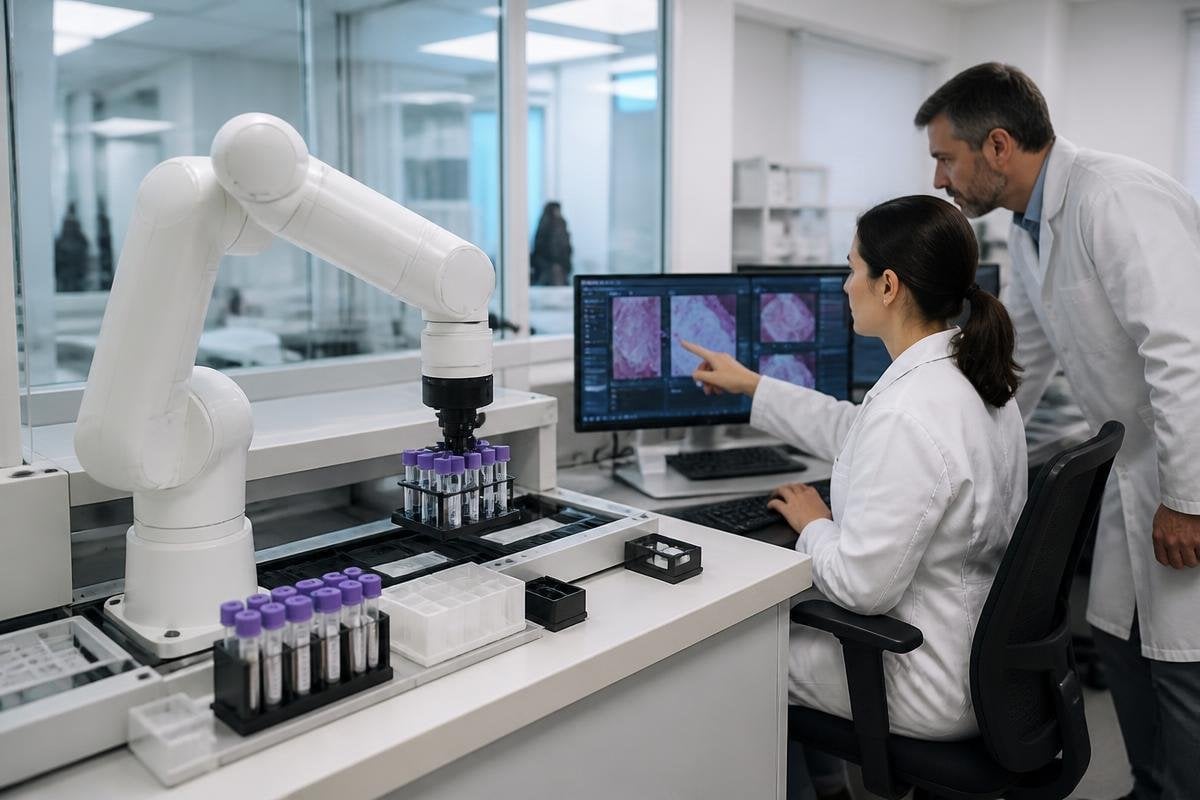
A robot can help doctors find disease sooner when it handles repeatable tasks, checks images, or moves samples through a test process. That does not make the robot a doctor. It makes the system around the doctor faster to check and easier to measure.
Quick read
- Robots can sort samples, guide imaging, and repeat routine checks.
- Earlier detection depends on the sensor, the software, and the doctor’s review.
- A hospital needs proof that the system works on its own patients.
Where robots can help
The clearest use is repeatable work. A robot arm can move a sample between stations, while software records each step. Mobile robots can carry materials through a hospital, leaving staff more time for patient care. Those tasks may shorten delays, but they do not detect disease by themselves.
Robots can also hold a camera or sensor in a steady position. That can help collect images in the same way each time. Consistent images give software a cleaner set of inputs to check, and they give doctors a better basis for review.
The medical decision still needs context. A scan, blood sample, or tissue image can point to a problem, yet the doctor must connect that result with symptoms, history, and other tests. When a robot flags a possible issue, it has started a review. It has not finished one.
What early detection depends on
Earlier detection comes from the whole chain working together. The sensor must gather useful data. The software must find a pattern linked to disease. The hospital must send a clear result to the right clinician without adding another delay.
That chain can fail in ordinary ways. A sample may be stored at the wrong temperature. An image may be blurred. Software trained on one group of patients may give weaker results for another group. A false alarm can send someone into more tests, while a missed sign can delay care.
This is why a hospital should ask for results from the setting where the system will run.
A lab result from a controlled trial may say little about a busy clinic with different equipment, staff, and patients. The useful question is whether the robot improves the time and quality of care after those conditions are included.
Medical automation needs more than a lab result. Medical robotics reporting from Robot24.com can place a machine’s claimed task beside its test setting, staffing needs, and limits. Those details lead to the checks doctors should make before trusting an early-detection claim.
What doctors should check
A purchase decision needs more than a demo. The hospital should ask for the details below before putting a system near patient care:
- Intended task: Does it sort samples, guide a scan, review images, or do another defined job?
- Measured result: What changed in detection time, error rate, or doctor workload?
- Patient match: Were the people and conditions in the test close to this hospital’s patients?
- Human review: Can a doctor see the data behind an alert and overrule it?
- Failure handling: What happens when the sensor, network, sample, or software fails?
- Cost and upkeep: Who services the robot, updates the software, and checks its results?
A system that cannot answer these points may still work in a lab. It has not earned a place in routine care.
The limits that remain
Robots do not remove the hard parts of diagnosis. Disease can look different across patients, and poor data can hide a useful signal. Software can also change the number of alerts without improving the final diagnosis.
Privacy adds another concern. Medical robots may handle images, samples, or patient records, so the hospital needs clear rules for storage, access, and deletion. Safety checks matter too, especially when a robot moves near a patient or operates imaging equipment.
I’d support these systems first where their task is narrow, their output is easy to check, and a doctor remains responsible for the decision. That path gives hospitals a way to measure real gains before they place a wider diagnostic burden on a machine.
A practical path for hospitals
Start with one defined task and record the current time, error rate, and staff workload. Run the robot beside the existing process, compare the results, and review missed cases as closely as successful alerts. If the system improves care without hiding its failures, the next question is whether it can keep doing so with the hospital’s own patients.
